
Head Office
TAPES WORLD
#147, Shop No. 004, Ramaiza Complex, Near Vishal Electronics, S.P. Road, Bengaluru-560002
Branch
TAPES WORLD
#59, ground floor, below HI ALT EXPERT,
8th main, J C industrial area, Bengaluru-560062
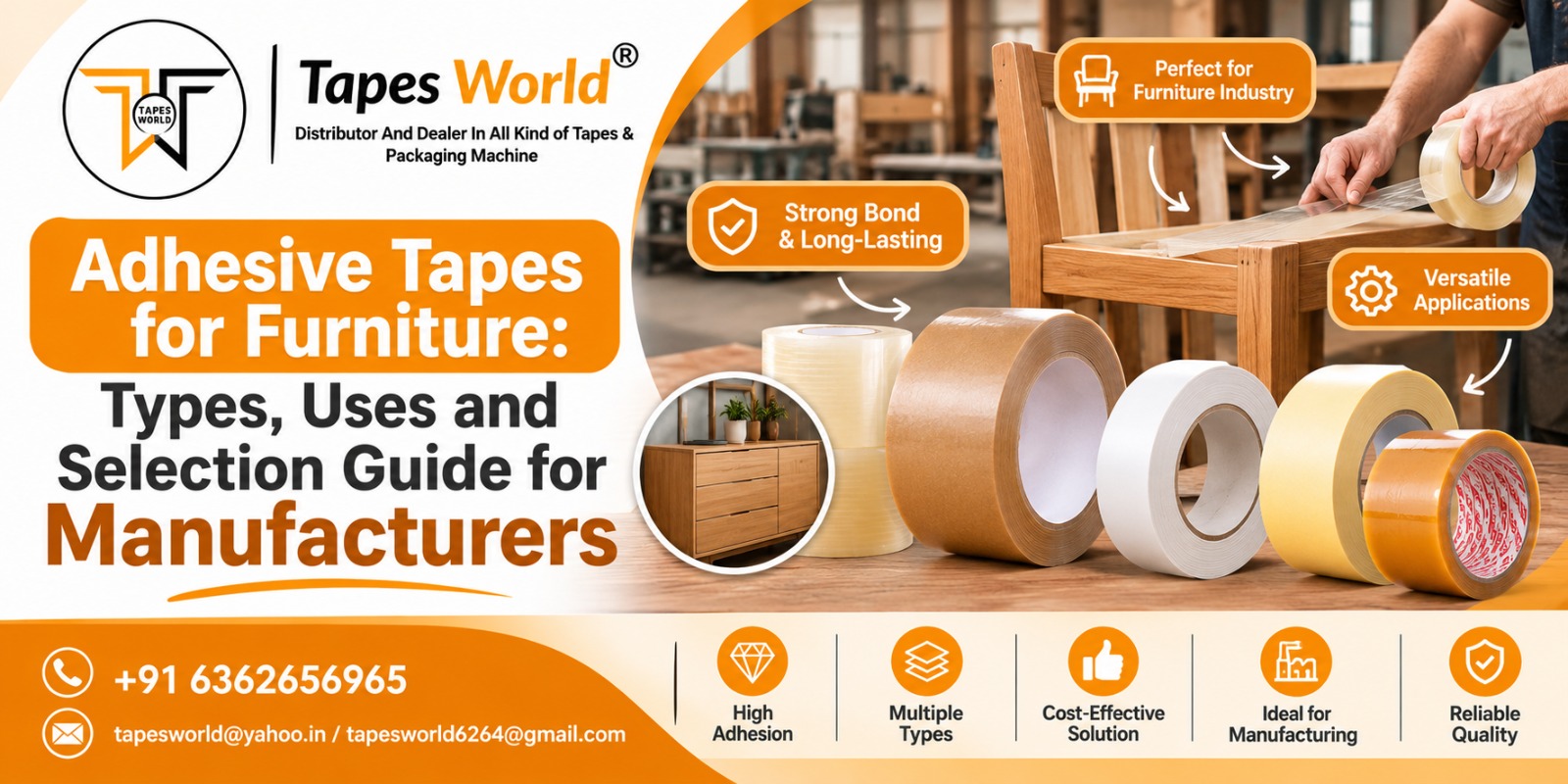
Adhesive tapes support many stages of furniture manufacturing, finishing, packing and installation.
They can hold components temporarily during assembly, attach selected trims or profiles, cushion contact points, protect finished surfaces and secure packaging for delivery.
Furniture materials vary widely, from solid wood and plywood to MDF, particle board, laminates, glass, metal and plastics.
Each surface has different characteristics, so a tape that works well on one material may not bond reliably to another.
Selecting tape based on the job, surface and expected service conditions helps improve production consistency and finished-product quality.
Furniture adhesive tapes are pressure-sensitive products used in furniture production, repair, installation and packaging.
They may have single-sided or double-sided adhesive, and backings made from foam, tissue, film, cloth or paper.
Their functions range from temporary positioning to longer-term bonding and surface protection.
The correct grade depends on the load, substrate, finish and whether the tape must remain in place or be removed.
1. Double-Sided Tissue or Film Tape
Double-sided tissue or film tape can be used for light attachment, positioning and selected trim applications.
2. Foam Tape
Foam tape can cushion components, fill small gaps and help bond uneven surfaces.
3. Mounting Tape
Mounting tapes are designed for particular bonding tasks, but their load limits and substrate requirements must be checked.
4. Masking Tape
Masking tape is useful for temporary masking during painting, polishing or finishing.
5. Surface-Protection Films and Tapes
These help reduce scratches during manufacturing, handling and installation.
6. Packaging Tapes
Packaging tapes secure cartons and protective materials for dispatch.
Furniture manufacturers may use tapes to:
Position decorative laminates or trims during assembly.
Hold components while another joining method is completed.
Protect polished or laminated surfaces.
Bundle accessories.
Secure protective wrapping.
Support selected modular furniture installation and finishing tasks.
For any permanent joint that carries structural load, use a validated adhesive or mechanical joining system specified by the product designer. General-purpose tape should not be treated as a structural substitute.
Plywood, MDF and Particle Board
These materials can differ in porosity, dust level and surface finish.
Laminates and Coated Boards
These may have lower surface energy or release agents that affect adhesion.
Glass and Metal
Glass and metal offer different bonding characteristics and require compatible adhesive products.
Identify both surfaces that the tape must contact and check the supplier's compatibility guidance.
For rough or uneven surfaces, a conformable foam construction may be considered.
For smooth surfaces, a thin film or tissue tape may suit certain light-duty tasks.
Always test on the actual finish because coatings and cleaning products can change adhesion.
Consider whether the tape is for:
Temporary holding.
Permanent attachment.
Cushioning.
Masking.
Surface protection.
Packaging.
Also check:
Required holding strength.
Tape thickness and width.
Roll length.
Temperature range.
Removal behaviour.
Residue and staining.
Compatibility with varnish, paint or laminate.
Application speed and dispenser compatibility.
Compare total application cost and reject rates, not only the price per roll.
Prepare surfaces according to the supplier's instructions.
Remove dust, loose fibres, oil and moisture without using cleaners that may damage the finish.
Apply tape evenly and press firmly to establish contact.
Avoid touching exposed adhesive with fingers.
Allow the recommended dwell time before applying load, where specified.
For temporary protection tapes, remove within the recommended time and angle to reduce the risk of residue or surface damage.
Test removal on an inconspicuous area before full-scale use.
Tape may lift if applied to dusty, oily or textured surfaces without suitable preparation.
Residue can occur when a protective tape remains in place beyond its recommended period or is exposed to unsuitable heat or sunlight.
Bond failure can also result from mismatched adhesive chemistry, insufficient pressure or applying the tape outside its recommended temperature range.
A small production trial can identify these issues before bulk use.
Which tape is best for furniture?
There is no single best tape. The correct option depends on whether you need bonding, cushioning, masking, protection or packaging.
Can double-sided tape stick to plywood or MDF?
Some grades can, but surface dust, porosity and finish affect results, so test first.
What tape protects furniture during transport?
Suitable surface-protection films, cushioning materials and carton-sealing tapes may be used as part of a complete packing system.
Can tape replace screws or wood adhesive?
Only in applications specifically designed and tested for tape bonding. Do not use general-purpose tape for structural joints.
For furniture manufacturing or installation, contact Tapes World with the materials, surface finish and intended use.