
Head Office
TAPES WORLD
#147, Shop No. 004, Ramaiza Complex, Near Vishal Electronics, S.P. Road, Bengaluru-560002
Branch
TAPES WORLD
#59, ground floor, below HI ALT EXPERT,
8th main, J C industrial area, Bengaluru-560062
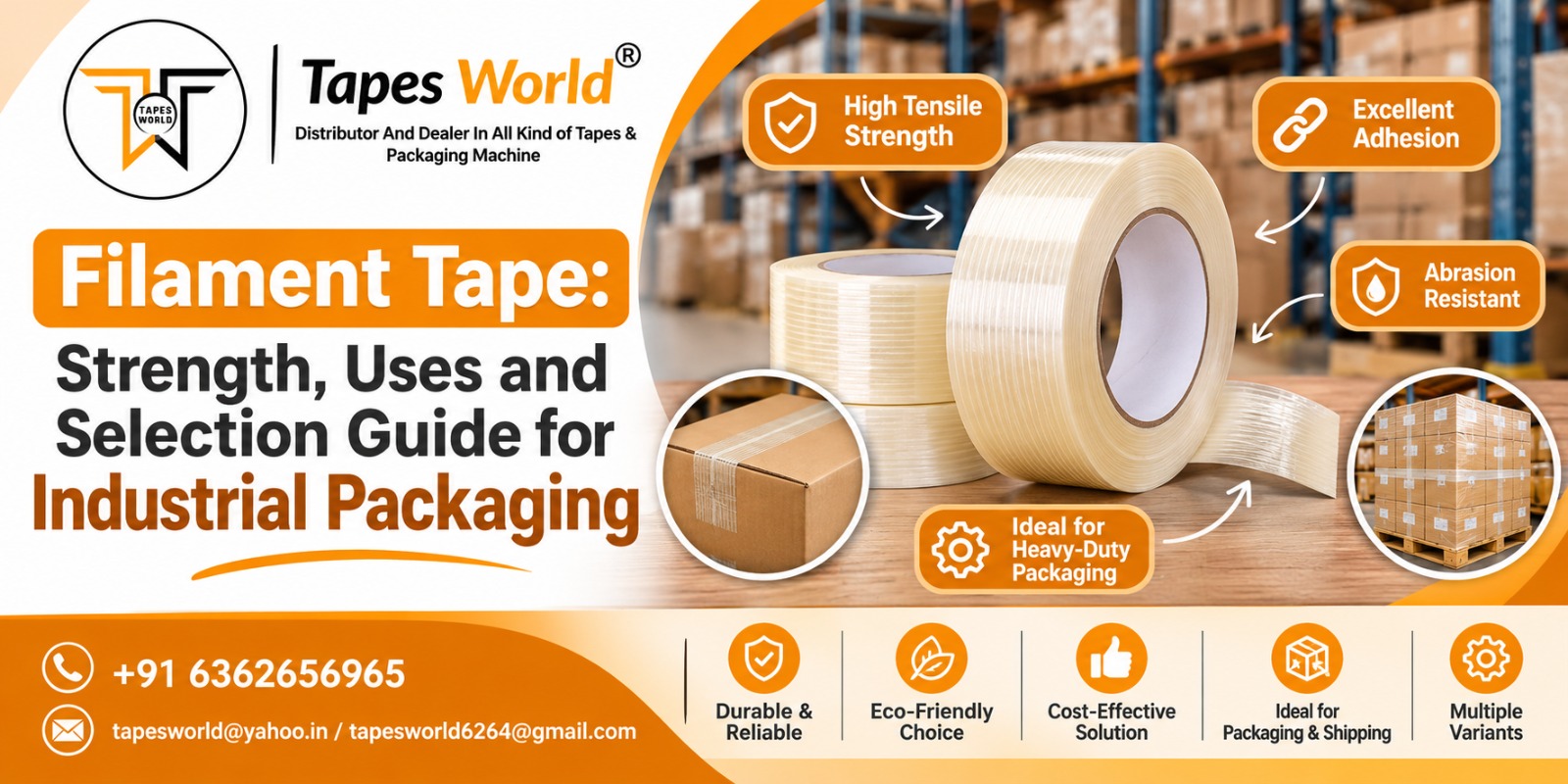
Filament tape is a reinforced pressure-sensitive adhesive tape designed for applications that need high tensile strength and dependable holding power.
It commonly combines a film backing with glass-fibre filaments running in one direction or in a cross-weave pattern.
This reinforcement helps the tape resist stretching and breaking under load.
Businesses use filament tape for bundling, reinforcing cartons, securing components and holding items together during storage or transport.
Choosing the correct grade is important because filament direction, adhesive, backing and application surface all affect performance.
Filament tape is a reinforced adhesive tape containing continuous or discontinuous glass-fibre strands embedded in or bonded to its backing.
Mono-directional tape has fibres running mainly along the length of the roll, while cross-weave tape includes reinforcement in both lengthwise and crosswise directions.
It is supplied in different widths, thicknesses and adhesive strengths for light, medium and heavy-duty applications.
The adhesive creates contact with the surface, while the embedded fibres provide reinforcement and help resist tensile forces.
This combination makes filament tape useful for holding bundles together and reinforcing packaging.
Performance is affected by:
Quality and orientation of fibres.
Adhesive formulation.
Tape width.
Surface cleanliness.
Application method.
Filament tape should not be treated as a substitute for engineered lifting or load-restraint equipment.
1. Mono-Directional Filament Tape
Mono-directional filament tape is reinforced mainly along the length of the roll and is commonly used for strapping, bundling and securing items in one direction.
2. Cross-Weave Filament Tape
Cross-weave filament tape has fibres in two directions and can provide reinforcement across a wider area.
3. Heavy-Duty Filament Tape
Different grades are available for carton reinforcement, bundling, pallet-related packaging and industrial holding tasks.
Always compare the manufacturer's technical specifications rather than relying only on the product name.
Filament tape is used in several industries and applications:
Bundling metal rods, pipes and profiles.
Securing components during transit.
Reinforcing carton seams.
Holding appliance or furniture parts in place for shipping.
Supporting warehouse packaging operations.
Keeping grouped products organised during manufacturing.
For pallet loads, it can be one part of a packaging system, but the complete load must be secured using methods appropriate to its weight, shape and transport risks.
The reinforced construction provides high tensile strength relative to many ordinary packaging tapes.
Other benefits include:
Helps keep grouped items together.
Resists splitting under tension.
Reinforces selected packaging areas.
Available in multiple widths and grades.
Convenient pressure-sensitive application.
Useful for industrial packaging and bundling.
Identify the task first: bundling, carton reinforcement, component holding or another application.
Consider:
Weight and shape of the items.
Surface type.
Direction of the load.
Impact and vibration exposure.
Temperature changes.
Mono-directional or cross-weave reinforcement.
Tensile strength and adhesion.
Tape width and thickness.
Compare the manufacturer's data sheet and test the tape under realistic conditions before adopting it for production or transport.
Apply filament tape to a clean, dry surface and press it down firmly to achieve good adhesive contact.
Use enough overlap and wraps for the application, following the supplier's instructions.
Cut the tape with an appropriate dispenser or cutting tool and handle exposed fibres carefully if the tape is torn.
Do not use packaging tape as a lifting sling, fall-protection device or certified load restraint.
For heavy or hazardous loads, use approved strapping and engineered securing systems.
Selecting tape only by apparent thickness.
Ignoring tensile and adhesion data.
Using mono-directional tape when cross-directional reinforcement is needed.
Applying tape to an unclean surface.
Using insufficient overlap.
Applying incorrect tension.
For critical applications, validate the complete packaging method, not just the tape in isolation.
What is filament tape used for?
It is commonly used for bundling, carton reinforcement and securing components during storage or transport.
What is the difference between mono and cross-weave filament tape?
Mono has reinforcement mainly in one direction, while cross-weave has reinforcement in two directions.
Is filament tape waterproof?
Resistance depends on the tape construction and product specification. Check the manufacturer's data.
Can filament tape replace strapping?
Not for every load. Use certified strapping or engineered restraint where required.
For filament tape selection, tell Tapes World what you are bundling or reinforcing, the approximate load, surface type and application conditions so the right grade can be evaluated.